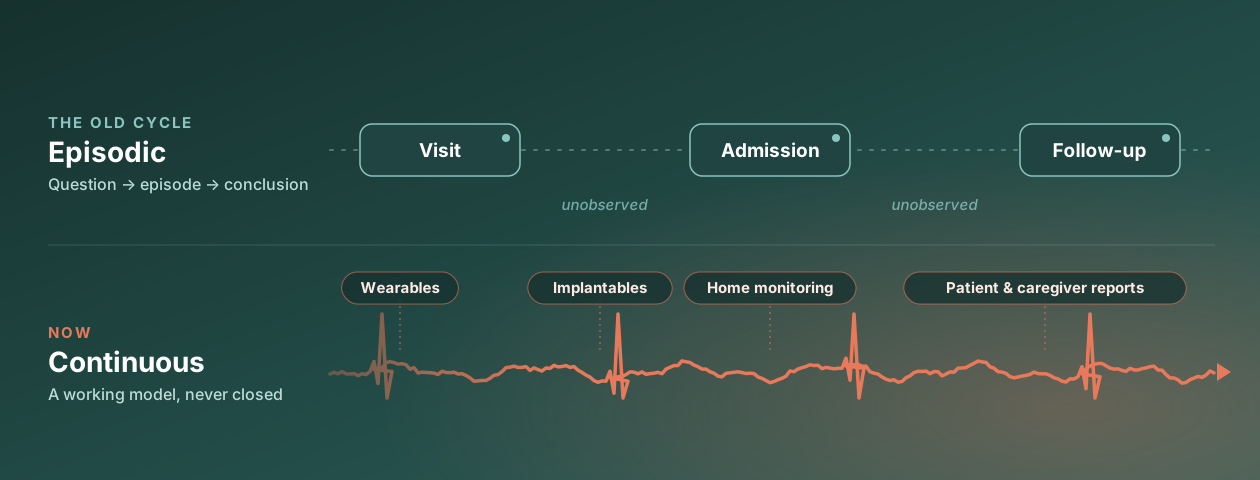


A couple of years ago, I had a pacemaker implanted to address an AV block. Naturally, one of my first questions was why the block had occurred in the first place. The answer, as is sometimes the case in medicine, was essentially that no clear cause could be identified (idiopathic causation, a wonderful phrase).
A few months later, I underwent a cardiac MRI. In my mind, this represented an extraordinarily detailed inspection of my heart. If there was a clue to the underlying cause of the condition, surely this was the kind of diagnostic procedure that might reveal it. The amount of information being collected seemed immense, and I found myself assuming that somewhere within that data there might be insights that had not previously been available.
When the results came back, however, the discussion focused entirely on a much narrower question. The MRI confirmed that the pacemaker implantation had healed properly and that everything appeared to be functioning as expected. From a clinical perspective, this was entirely appropriate. The imaging had answered the question that had motivated the study. What struck me afterward was not that the analysis had been inadequate. It was that the richness of the underlying data seemed wildly disproportionate to the narrowness of the question being asked of it.
Here was an extraordinarily detailed representation of a human heart. Significant expertise had been involved in acquiring it. Significant cost had been incurred. Yet once the immediate clinical question had been answered, the images themselves effectively disappeared from the ongoing clinical narrative. They were archived, preserved, and available if someone chose to revisit them, but for practical purposes they had become inert.
The more I thought about it, the more I realized that this is not unusual at all. In fact, it is deeply embedded in the way modern healthcare information systems operate.
A CT scan, an MRI, a laboratory panel, or a diagnostic procedure is typically performed in response to a specific question. The resulting data is analyzed, interpreted, and summarized. What ultimately becomes part of the patient’s longitudinal record is not the data itself, but the conclusion. The healthcare system is remarkably good at preserving answers.
What it is far less equipped to do is preserve the broader space of questions that might later be asked as new information emerges. That distinction may not have mattered very much when medicine was primarily episodic. Increasingly, however, I am beginning to wonder whether it matters a great deal.