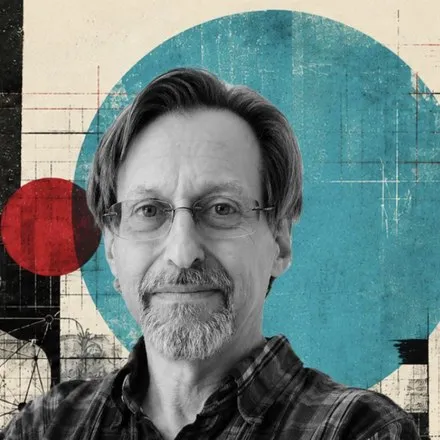
Two founders, two decades of living inside the same gap in healthcare — one from the engineering side, one from a
hospital waiting room. This is that story.
MIT-trained engineer (EE & CS) with 16 patents and 30+ years building, commercializing, and incubating frontier technology in IoT and health tech. Former CTO and Chief Architect at Motive Medical Intelligence, where he originated the "Active Context Graph" architecture for GE's Predix platform — the technical lineage behind this system's core reasoning approach.
The motivation
"I showed up at a hospital one day and it turned out I had an AV block. I asked why that happened. Idiopathic causation — basically, stuff happens. The doctors were happy with that explanation, because they'd determined there was nothing threatening beyond the current problem. That was the end of the story for them.
They put in a pacemaker. Three months later, they sent me for a cardiac MRI. I was thinking: ten gigabytes of data, hundreds of image slices of my heart — somebody is going to tell me something useful.
What came back was a report answering one specific clinical question: did this thing heal correctly? Good — it did. I was very happy about that. But what about all that other information? That data could have been run through an array of machine learning models, producing a number of anomaly observations — things that might mean something. But that has no place in the settled record, because it doesn’t answer a current clinical question.
The doctors had already determined there was nothing further to do right now. So they weren’t asking any further questions — and those observations were never made, because they had no place to live.”
Former Co-Founder & CEO of TechVariable, an AI & analytics software company serving US digital health and value-based care clients, which he bootstrapped to profitable, multi-million-dollar revenue over a decade before its acquisition in 2026. Deep expertise in US healthcare GTM, interoperability, and CMS-driven solutions, built running distributed sales teams across the US and India.
The motivation
In 2016, my mother underwent open-heart surgery to close a hole in her heart she had likely been born with — an ASD, an atrial septal defect. She was 60. Going into it, the surgeons weren't certain she would recover well. She did. But the surgery didn't end the story — it started a new one.
In the years since, she has been on a carefully balanced combination of medications: one to keep her heart rhythm steady, another to control the rate at which it beats, one to help the heart muscle pump more effectively, and a diuretic combination to keep fluid from building up.
She’s also on a blood thinner to prevent clots, and a medication to manage pressure in the blood vessels of her lungs. Together, they are not a checklist — they are a single, interdependent balance, adjusted over years against how her particular heart actually behaves. Her normal resting heartbeat is not what a textbook would call normal. Her normal blood pressure isn’t either. These aren’t abnormalities to be corrected — they are normal, for her, now.
A few years in, her kidneys began to show strain — not a coincidence, but a direct consequence of the very medications keeping her heart stable. Her diuretics push her kidneys to clear fluid; her blood thinner is cleared by her kidneys; any future adjustment to her heart medication now has to be checked against a kidney number that itself keeps moving. No single doctor managing one piece of it can see the whole picture.
Then came a procedure that had nothing to do with either — a routine surgery in an entirely different department. Suddenly a team with no history with her had to make decisions in days that her cardiologist and nephrologist had spent years building: whether her rhythm medication changes how she’d respond to anesthesia, whether the standard painkiller was safe for kidneys already under strain, whether her blood thinner could pause and for how long. None of this was written down anywhere the new team could easily find. It fell into the space between departments — protected only by whichever family member was in the room, repeating her history for the fourth time that week.
And all of this happened around two systems that already existed and worked exactly as designed. Every echocardiogram, every kidney panel, every specialist consult was a real, expert answer to a real question — sharp and correct in the moment, then quietly archived the instant that question was answered. Her official medical record faithfully logged every prescription, every order, every visit — an accurate filing cabinet of what was decided, never why, never what it meant alongside everything else. Both systems did their job. Neither was ever meant to hold the third thing: the living understanding connecting a decade of scattered facts into one coherent, evolving picture of her.
That gap shows up again in the smallest, easiest-to-miss ways. A scan from three years ago, noting a minor change near her original repair site, judged insignificant at the time. A resting heart rate drifting slightly over the past few weeks — nothing alarming on its own. Read separately, neither means anything. Read together, they might be the first real signal worth a second look. But nothing today is watching for that moment. It simply waits, correctly filed, for a doctor to happen to remember it exists — which, a decade and several departments later, is exactly the kind of thing that gets lost.
This is what a decade of managing her care has actually looked like: not one crisis, but a long accumulation of moments where the facts were all technically available somewhere, and the thing that was missing was never more data — it was something holding all of it together, continuously, the way her longest-serving cardiologist does in his head, except available the moment any doctor needs it, not only him. Her story isn’t an edge case. It’s what happens, quietly, to millions of people managing more than one serious condition over years.
Write to the founders directly about how you can contribute — we're looking for Founding Engineers, and
for Clinicians to join our advisory board. Reach out via Keith's or Nilotpal's LinkedIn, or by email above.